
Bending the attrition curve at Phoebe Putney.
How a 5,500-person Georgia health system gave its workforce relief from $1.7M in personal debt, with no cost, no IT integration, and adoption levels that placed it among the most highly engaged voluntary benefits they've ever offered.
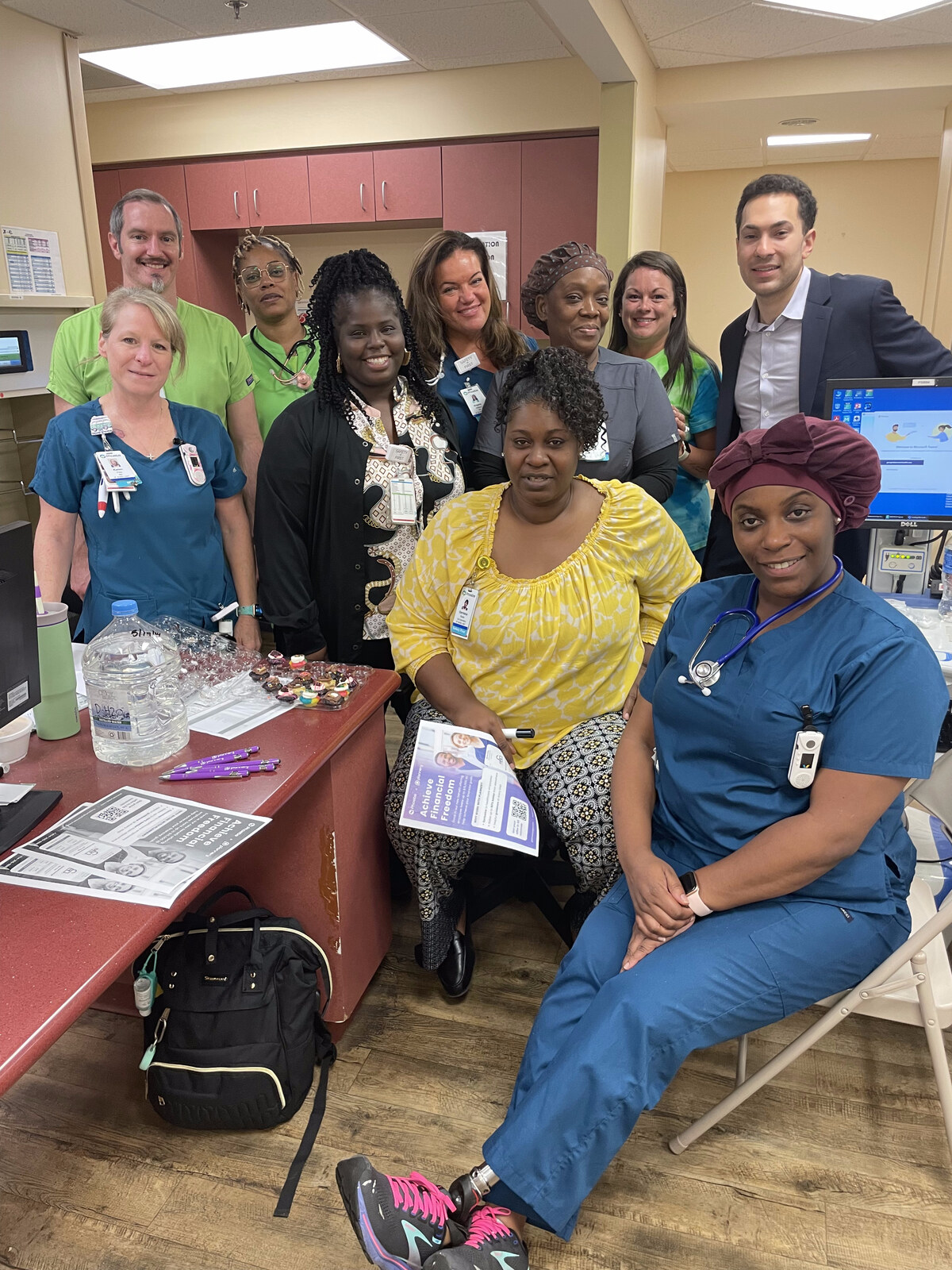
A 5,500-person workforce. A new pillar of total wellness. Adoption levels that exceeded every projection.
Phoebe Putney Health System has long approached employee wellness holistically: physical, mental, occupational, spiritual. In 2024, leadership added the pillar most health systems have left untouched: financial health.
The decision was not framed as a perk or a giveaway. It was framed the way Phoebe frames every workforce investment, as a question of whether the organization was caring for the people who care for patients. The answer, in this case, was that something was missing.
Twelve months after launching Plannery, a financial wellness platform built exclusively for healthcare workers, roughly one in three eligible employees engaged with the product, making it one of the most highly adopted voluntary benefits Phoebe has ever offered. Caregivers have consolidated over $1.7 million in personal debt, with the average employee paying down $8,638 at rates 30 to 60 percent below what they could find elsewhere. None of it required a dollar from Phoebe's budget, an integration from its IT team, or an administrative process from its HR staff.
This is the story of why Phoebe Putney decided to act, how it chose its partner, what implementation actually looked like, and what its employees did when they finally had the option.
A community health system serving 41 counties in southwestern Georgia.
Phoebe Putney Health System is one of the most innovative regional health systems in the Southeast. The organization serves a 41-county area in southwestern Georgia with a workforce of more than 5,500 physicians, nurses, and professional staff. In April 2025, Phoebe was named to Forbes' ranking of America's Best Employers, a recognition that reflects a deliberate, multi-year commitment to caregiver wellbeing.
That commitment runs from the top. Phoebe's well-being strategy was spearheaded by the CEO and operationalized by a cross-functional well-being committee that meets regularly to track engagement across every dimension of employee health.
Financial stress is a clinical workforce problem. Most organizations don't act on it.
Healthcare workers carry a financial profile that bears little resemblance to the rest of the U.S. workforce. They typically begin their careers late, after years of schooling that produced both student debt and the credit card balances that come with living on limited income. Once they're earning, their credit reports still tell the story of who they used to be, not who they are now.
The numbers are stark. In a HealthStream survey of more than 10,000 nurses, 75% reported experiencing financial stress. Nearly half (45%) said they could not cover a $400 emergency expense with cash on hand. For an industry already managing burnout, turnover, and retention pressure, these are not background statistics. They are signals.
At Phoebe Putney, leadership had been listening to those signals for some time. They heard them in employee opinion surveys. They heard them in conversations with caregivers who didn't always say the words "financial stress" out loud but who described its symptoms clearly enough.
The conventional toolkit (an EAP, a financial planning seminar, an occasional webinar) can teach employees about money. It cannot solve the underlying math of a credit card charging 29% APR. Phoebe's leadership wanted a tool that would address the actual problem on actual balance sheets.
A well-being strategy is incomplete without financial health.
Phoebe Putney's well-being framework already covered the dimensions most large employers attempt. Onsite fitness and employee health programs addressed the physical pillar. An onsite employee assistance program covered mental health. The organization's chaplaincy office supported spiritual wellbeing. Tuition assistance handled intellectual development. Each pillar was deliberate, and each had its own internal owner.
What leadership came to see, gradually then unmistakably, was that financial health was the pillar everything else leaned on. An employee under acute financial pressure cannot fully benefit from a fitness center, a chaplain, or a tuition program. Their attention is elsewhere. The question was not whether financial wellness mattered. It was whether Phoebe was willing to be one of the first health systems in its region to do something operationally meaningful about it.
Physical
Employee health, fitness, onsite care.
Mental
Employee assistance program with onsite providers.
Spiritual
Chaplaincy office.
Occupational
Safety, ergonomics, career development.
Intellectual
Tuition assistance.
Financial → added 2024
The missing pillar. Personal debt support for clinicians.
The strategy also had a sponsor at the top. Phoebe's CEO had personally spearheaded the formation of the system's well-being committee, and that mandate gave HR and Total Rewards license to evaluate solutions that didn't fit the conventional vendor mold.
The retention case wrote itself.
Phoebe's HR leadership also recognized the business case underneath the wellness story. Healthcare turnover is expensive, and the most expensive turnover is the kind that happens for the smallest reasons. A clinician leaving for $1 or $2 more an hour, not because the next role is better, but because the math at home isn't working. A program that materially improved take-home pay was, in effect, a raise that didn't require a raise.
A platform built for clinicians, not adapted for them.
Phoebe's first encounter with Plannery happened the way most enduring partnerships do: in a hallway. Joe Zuniga, Phoebe's Corporate Director of Total Rewards, attended the Georgia Hospital Association conference and met Krish Gopalakrishnan, the founder of Plannery. What stopped him was not a feature demo. It was the founder's story.
What Plannery does, mechanically, is unlock credit for clinicians that the rest of the financial system will not. Healthcare workers carry credit card balances that average $8,000 to $12,000 at interest rates above 30%, and the conventional credit-scoring model treats them as elevated risks because of how their balance sheets look at the start of their careers. Plannery's underwriting accounts for the context (credentials, profession, tenure) that traditional lenders ignore. The result: clinicians who would otherwise be steered toward payday loans or pawn shops qualify for refinancing at rates up to 60 percent below market.
For Phoebe, the qualitative fit mattered as much as the product mechanics. Three signals stood out:
Healthcare-only
Not a generic financial wellness platform with healthcare features. A product built for clinicians from the underwriting model up.
Mission-aligned
A founder driven by a family member's experience, the same operating premise as Phoebe's caregiver-centered mission.
Risk-free to deploy
No cost to the system. No fiduciary exposure. No IT integration. The administrative case to leadership wrote itself.
Anthony Lewis brought the program to senior leadership not as a perk but as an engagement and retention play, with a payback measured in turnover avoided rather than license fees. Phoebe's leadership team has a stated preference for being first, for taking responsible early bets on solutions other systems will later wish they had, and Plannery offered exactly that profile.
Hands off, by design. Zero administrative burden.
For Phoebe's HR and IT teams, the most important attribute of Plannery was the one that didn't exist: a project plan. There was no integration to scope, no contract review for liability transfer, no employee data exchange to negotiate, no claim system to staff. The "implementation" was approval, communication, and access.
What Plannery handled
- Employee onboarding flow: application, eligibility, underwriting, funding.
- Customer support, for every employee question, before and after enrollment.
- Compliance and lending operations. Plannery, not Phoebe, carries the regulatory and lending responsibility.
- Communication assets: collateral, enrollment events, employee-facing content.
- Measurement: adoption, savings, and impact reporting back to Phoebe leadership.
What Phoebe did
- Approved the program (a single decision from HR leadership).
- Added it to the benefits platform: a single link, so employees could find it where they already manage their benefits.
- Promoted it (included it in standard benefits communication and on-site enrollment events).
- Had regular check-ins with Plannery to review adoption and outcomes.
The "is this too good to be true" question came up. It came up from senior leadership. It came up from line managers. And it kept coming up until, twelve months in, the adoption data answered it.
What 5,500 caregivers did when they finally had the option.
Within the first twelve months of launch, Plannery became one of Phoebe Putney's most highly adopted voluntary benefits. The take-up rate, the dollar volume, and the per-employee impact all exceeded what the team had projected, and they had projected aggressively.
Engagement at scale, not at the margins.
The 30% applicant rate is not a marketing-funnel number. These are employees who completed the full Plannery application (including credit pull and underwriting) within the first year of the program. That depth of engagement is rare for voluntary benefits, where take-up of 5–10% is typical for highly visible programs and 1–3% is common for niche ones. Phoebe was at one in three.
Hard dollars for the people who needed them.
The $1.7M figure represents actual debt consolidated: credit card balances, personal loans, and high-interest unsecured obligations replaced with a Plannery refinancing at meaningfully lower rates. For the ~200 employees who funded a Plannery loan, the average balance moved was $8,638. Plannery's own measurement indicates these enrollees save approximately $3,800 per year in interest costs, an annual benefit Joe and Anthony describe, plainly, as the equivalent of a $2,000-per-year raise that didn't require a raise.
Retention: the metric that mattered most.
The well-being case was clear from day one. The retention case became clear over the next twelve months. In Plannery's analysis of Phoebe's enrollee cohort, employees who engaged with the program are 76% more likely to stay with the system than comparable peers who did not. The mechanism is intuitive: clinicians who leave for $1 or $2 more an hour are rarely doing so because the new job is better. They are doing so because the math at home is broken. Plannery does not fix every reason a caregiver might leave. It removes one of the most preventable ones.
What Phoebe's caregivers said.
Adoption metrics tell one story. The people behind those metrics tell a different one. Below, in their own words, are four Phoebe Putney employees on what the program meant to them.
"Why didn't we roll this out sooner?"
Twelve months of data made the program's value undeniable. But for Anthony Lewis, the more lasting insight was less quantitative. It was about how much financial hardship was hiding in plain sight inside Phoebe's workforce, and how few employers are giving caregivers the option to address it.
One of the conversations Anthony refers to happened in the Phoebe cafeteria, where an employee stopped him to thank him for rolling the program out. Her response, and dozens like hers, surfaced a question that has stayed with the team: why didn't this exist sooner?
That is the question Phoebe's leadership now puts to peers across the industry. Financial wellness is not a marginal benefit. It is the benefit your workforce will not tell you they need, until you make it available.
A program that has earned its way into Phoebe's everyday benefits language.
The Plannery program is now embedded in Phoebe's benefits platform as a permanent fixture, accessed by employees through the same surface as their health, retirement, and tuition benefits. Joe and Anthony describe it not as a pilot but as one of the best things we offer. The team continues to track adoption, savings, and retention impact in regular reviews with Plannery, and is exploring deeper integration into onboarding and benefits communication so that new caregivers encounter the program from day one.
For Phoebe, the broader lesson is that workforce wellbeing is operational, not ornamental. The most durable employer-of-choice strategies are the ones that change real numbers on real paystubs, and that take the cost, complexity, and risk off the table for the system itself.
Bring financial wellness to your caregivers, without the cost, the IT lift, or the risk.
Plannery is free to deploy for hospitals. We handle the application flow, the underwriting, the customer support, and the compliance. You make it available.
Start a conversation